
Game Boosting Services
Customer: Pursuant to the NDA, we cannot disclose the project name.
Case study: Game Boosting Services
Services: Google Ads contextual advertising
Industry: WoW game boosting services
Review period: Jan-Dec 2020
Features
The website provides professional game account boosting services and online games coaching. Users from the United States and Canada are priority audiences to promote to.
The main feature is intense competition among advertisers and volatile service demand (the more time passes after the update has been released, the larger decrease there is in service demand).
The audit results of the advertising campaigns revealed that the previous contractor paid little attention to their optimization and caused customer’s disappointment at how low conversion rates were.
Ultimately, we decided to reset contextual advertising because of the limited effect of the current advertising campaigns.
Mission
To increase conversion rates as opposed to the previous contractor, given that only if a request has been made through a website can it be considered a conversion.
Action plan
- Studied primary competitors, their pricing policies, and USPs.
- Carried out a supply and demand analysis of each advertised product category.
- Developed a promotional strategy of each advertised area.
- Aligned and approved the budget of each advertising campaign. Gradually increased the budget guided by the efficiency and effectiveness of the campaigns.
- Analyzed the target audience. Compiled a conversion portrait of the buyer while analyzing and managing advertising campaigns.The portrait is outlined below:
- Age: 18 – 44 + undefined
- Gender: men + undefined
- Interests: Media & Entertainment
- Conversion volume on a time of day basis: from 10 p.m. to 6 a.m. GMT+ 03:00
- Devices: desktops
- Developed advertising campaigns:
- Re-collected and regrouped keywords taking into account phrase and exact matches of search phrases to further assess their effectiveness and reduce the cost of advertising appeals.
- Divided advertising campaigns into product categories.
- Focused on the quality of ad development and relevance.


Example of an expanded ad in Google Ads
- Fine-tuned advertising campaigns based on the portrait of the target customer.
- Added all ad extensions available (quick links, callout, structured snippet, price, and promotion extensions).
- Great emphasis was placed on repeat purchases since users constantly need to improve their game accounts in this regard. Therefore, the following user segments were created for Remarketing:
- Segmented users based on the number of days since they last visited the website.
- Created a user segment called “Added to cart, no purchase”.
- Used creatives to promote the most popular categories and products.
- Used display ads to attract social network users.

Example of a creative
The final structure of the Google Ads account is given below:

Ad account structure
The following parameters were identified in Google Ads over the review period:
Basic metrics:
- Number of clicks — 29,700
- Cost — $61,474.3
- Avg. cost-per-click – $2.07
Conversion metrics:
- Number of orders placed — 1,943
- Conversion rate — 7.66%
- Value of all conversions — $163,605
- Cost per action — $31,64
- ROMI (Return on Marketing Investment) =Revenue-CostsCosts*100%=166.14%

Basic metrics
Behavioral metrics:
As shown in the table below, compared to the previous period the number of users and sessions decreased by 30.19% and 34.03% respectively, whereas behavioral metrics improved considerably, namely:
- Bounce rate decreased from 56.82% to 27.23% (or by 52.07%)
- Avg. page depth increased from 2.15 to 3.44 (or by 60.27%)
- Avg. session duration increased from 02:10 to 04:03 (or by 86.01%)
This is mainly due to a carefully defined target audience and expert website promotion.
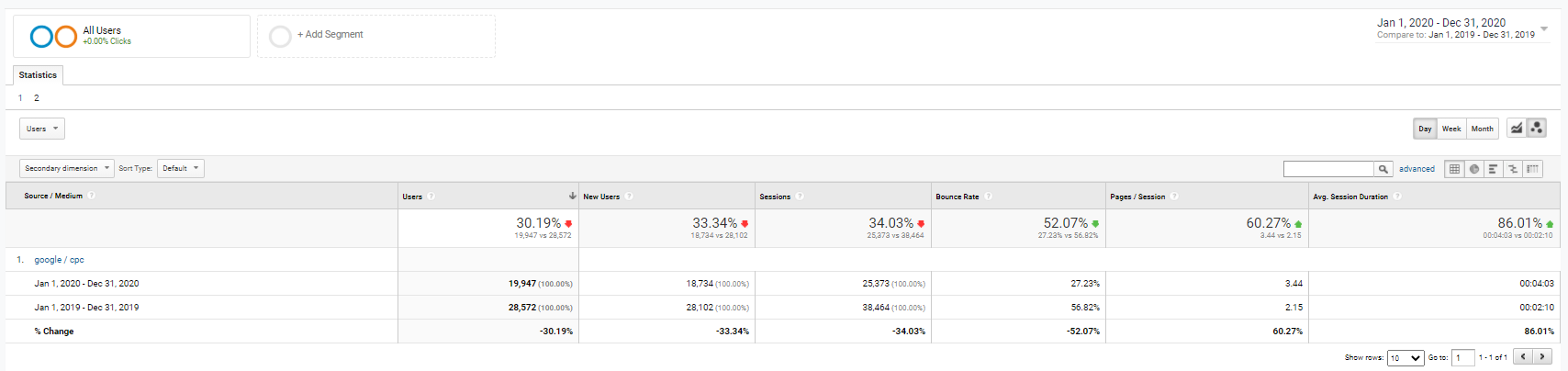
Behavioral metrics
Putting it all together
To ensure maximum benefit various promotional strategies and hypotheses were tested while running the 2020 contextual advertising campaign:
- Segmented the target audience to obtain the best possible results.
- Used dynamic keyword insertion in ad headlines to increase ad relevance.
- Launched a dynamic search campaign to be shown on search results page upon long-tail queries.
- Only used targeting in limited campaigns to reach new users and drive sales within this ad group.
- Used conversion strategies to obtain the largest number of conversions and increase revenue.
- Used targeting tools among competitors’ audience.
- Used video ads on YouTube to find new channels of communication with target customers.
- Used promotional codes in display and search ads to attract new users.
Those efforts resulted in a significant increase of conversion rates compared to 2019:
- Number of orders placed increased by 150.39%
- Rate of converting traffic into sales increased by 279.57%
- Value of the received conversions increased by 148.63 %
- Average cost per action reduced by 19.86%
- ROMI increased by 44.73%
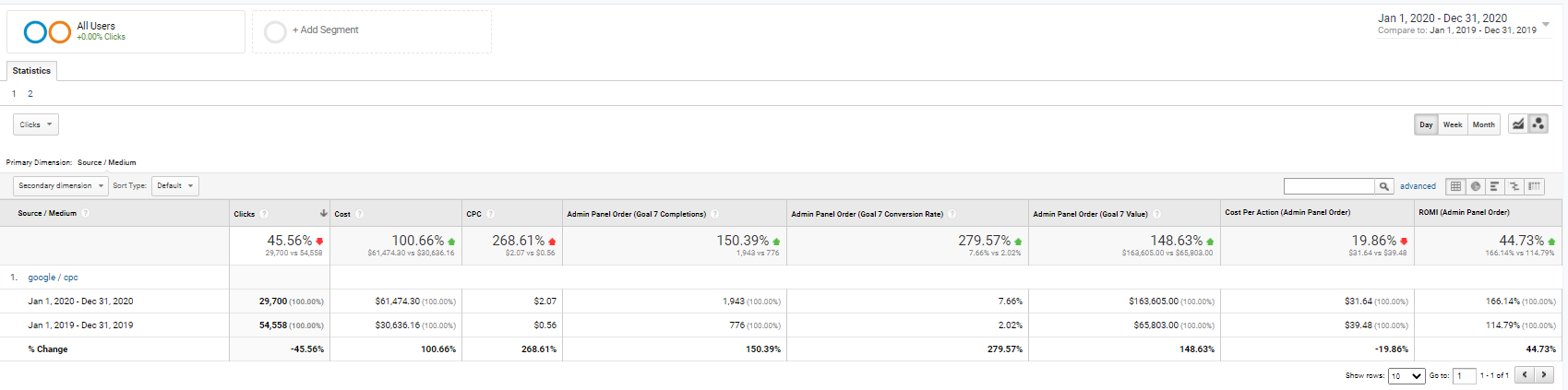
Period comparison
Ultimately, contextual advertising in Google Ads generated revenue of at least 163,605 USD at a cost of 61,474 USD. Future plans include increasing the number and scale of advertising campaigns, launching new campaigns (Discovery, Gmail, etc.), targeting new audiences, and building new creatives in the display network.
Client:
Pursuant to the NDA, we cannot disclose the project name.
Case study:
Game Boosting Services
Review period:
Jan-Dec 2020
Category:
PPC